A narrow Q-factor for better aerodynamics. Really?
Today we’re talking about the latest trend in cranksets for triathlon and time trial bikes, specifically the extra narrow Q-factor for improved aerodynamics. This basically means reducing the distance between…
Datum
Lesezeit
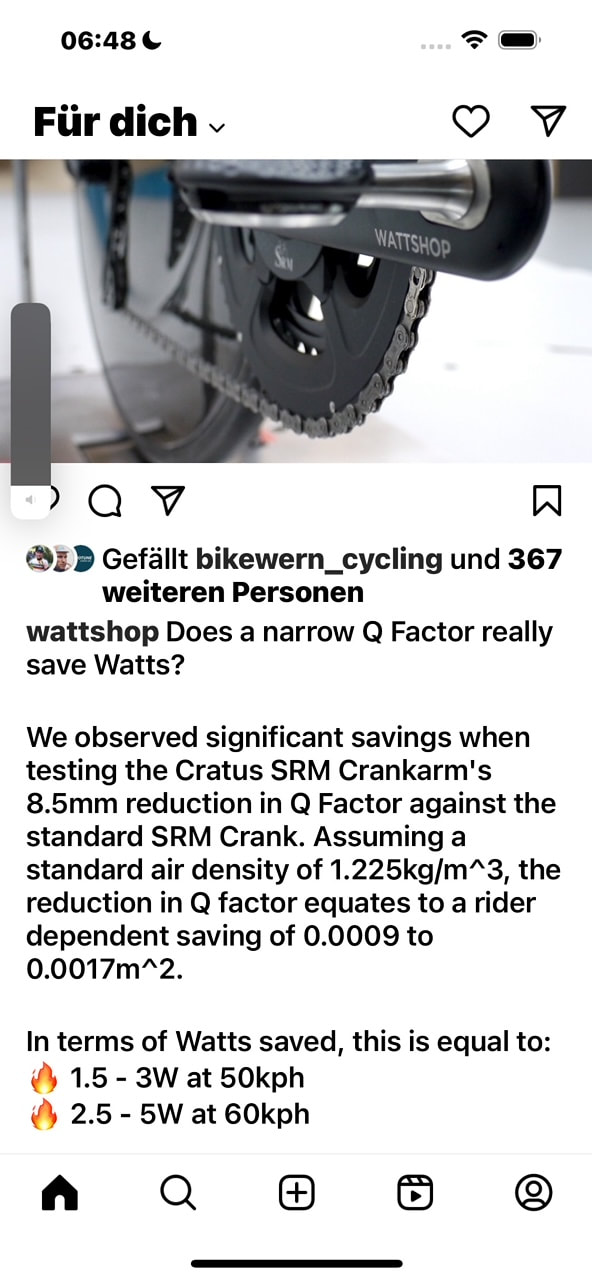
Today we’re talking about the latest trend in cranksets for triathlon and time trial bikes, specifically the extra narrow Q-factor for improved aerodynamics. This basically means reducing the distance between the crank arms to make them more aerodynamic. According to the UK-based manufacturer Wattshop, this can save you around 1.5 to 3 watts when cruising at 50 km/h. Roughly speaking, that is.

But let me tell you, this idea isn’t exactly groundbreaking. When I recently came across it, I had to do a double-take. Over the years, I’ve developed a bit of a BS detector for these blanket claims, and it was buzzing loudly here. Because this idea isn’t as fresh and universally applicable as it’s made out to be; in fact, it can lead to problems for many cyclists. Trust me, I’ve experienced it firsthand.

So, what exactly is this Q-factor?
It’s the distance between the outer edges of the crank arms on a bike. Think of it as the space where the pedal axle attaches to the metal or carbon. For modern road and time trial bikes with 12-speed drivetrains and disc brakes, that distance is roughly 144 millimeters. Why does the drivetrain and brakes matter? Because twelve gears, a disc brake, and a thru-axle at the rear require more space than, say, a quick release and fewer gears like we had in the past. Plus, there’s the chainline, which needs to connect the rear to the front without the crank rubbing against the frame or the front derailleur. Off-road bikes, with their wider Q-factors, can measure up to like 174 millimeters.
By slightly embedding the pedal axles into the crank arms, you reduce the Q-factor, meaning the pedals and consequently your feet are a bit closer together. However, there are pedals designed with biomechanics in mind that use longer axles. For instance, Shimano’s SPD-SL model offers an extra 4 millimeters of length on each side.

But wait, don’t confuse this with automatically increasing the Q-factor. Shimano calls it “Stance” when you pedal with longer axles.
https://bike.shimano.com/en-US/information/news/shimano-dura-ace-and-ultegra-long-axle-pedals-enhancing-stance-w.html
Here’s an interesting tip from Japan: If you regularly switch between mountain biking, gravel, and road cycling, longer axles on your road bike might be beneficial. They bring the Q-factor closer to what you’re used to with off-road bikes with knobby tires.
Another pedal manufacturer, Garmin, offers the RS 200 pedals with a 2mm spacer on each side. This is primarily to prevent the rear of the pedal axle, where all the measuring technology is housed, from colliding with the chain depending on the crank thickness. I personally prefer either Shimano’s 4mm longer axles or the RS 200 with spacers.
Magnus Ditlev, whom I’ve recently covered for triathlon magazine (in issue 221, out on May 22nd), opts to remove the spacers from his Torno Carbon cranks from 3T, which already measure a slim 142 millimeters, because it’s biomechanically beneficial or at least not harmful. The Wattshop version for road bikes measures even narrower at 138 millimeters.
And now we’re getting to where I’ve been leading you all along: the Q-factor is only half the story. Pedal axles and pedal cleat position are equally crucial, and let me go a bit more in depth.
Back in the day, there was a craze for riding with narrow setups. There was even a frame called Walser after its builder, with an extra narrow bottom bracket and rear triangle, into which only special cranks and rear wheels fit. All in the name of reduced frontal area and supposedly better aerodynamics. It was so popular that Ulle rode one repainted as a Giant, Timo Bracht had one branded as Cucuma, the Gerolsteiner pros rode Specialized versions, and some Lothar rocked a Cube-themed one. Focus tried to adapt the Walser principle to mass-produced time trial frames for their Milram team, but quickly abandoned it. Interestingly, many of the top riders at the time also used zero-adjustment aerobars from Walser, along with a riding position that would make us laugh today. The idea was to push the wind downwards by inflating arms and upper body like a parachute, with completely straight extensions pointing, yes, downwards.
Speedplay used to offer extra short pedal axles for their Zero pedals made of titanium, to bring the feet even closer together. I used them on all my bikes back then and felt super tuned up. I was willing to put up with the downside that my feet’s outer edges would hurt after long time trials and 180-kilometer relays in Roth, to me, it was all about being more aero. Side note: Speedplay is now owned by Wahoo, and you can still buy longer axles for the Zeros, but only longer than the standard 53 millimeters.
Relief finally came through bike fitting by Dr. Andy Pruitt, the man behind Specialized’s BG Fit System. He convinced me to ditch the narrow stance because, here’s the kicker, I wouldn’t be able to stand or walk properly, let alone cycle, with such a narrow stance. So, I switched to even longer than standard axles. Another, less involved option for this is adjusting the cleat plates sideways slightly, to align the center of the foot over the lollipop-shaped pedal body of the Speedplay Zero, instead of causing lateral pain when pushing for a long time. For all time trialists and triathletes, a modification is recommended, which I’ve been using since then: moving the cleats all the way back instead of the old-school under the ball of the foot position, which promotes even power transfer during time trials. However, this setup is different for efforts requiring spikes in power, like sprints, MTB or hill climbs.

Because this fits so nicely and serves as a great segue, here’s part 1 of today’s advertisements.
If you’re riding with Speedplay and/or Wahoo Speedplay Pedals Type Zero, you’re well served with matching stainless steel plates that fit between the pedal plate and plastic adapter (when using three-hole shoes with a four-hole adapter). And/or, if you’re riding with expensive carbon soles with four-hole mounts for the Zero pedals, you can immensely extend the lifespan of your expensive shoes with them. You can get these parts from me at derbaranski.shop.


The pedal movement and the watts you generate through the bike system only really become a shoe as we say in German (funny here, eh?) when you have the right insoles, regardless of which pedal system you’re using. For a few years now, I’ve been a big fan of the BLK version from Solestar in Cologne, which you can get from me risk-free. If you’re not satisfied within six weeks, just send them back to me and get your money back.

By the way, the mastermind behind the Solestar insoles is Oli Elsenbach, whom I’ve previously blogged about.

When Oli gets into it, things quickly get nerdy and hands-on. He’s conducted numerous tests on leg axles and narrow cranks, including with national track riders on their FES bikes and with his own FES power meter, which measures left/right separately. According to Oli, while those bikes (because they lack drivetrains and brakes) can be built extremely narrow, only three out of ten test subjects actually benefit from it. When large and wide riders are set up too narrowly, it usually backfires, much like it did for me as a hobbyist cyclist ten years ago on a road bike. According to Oli, the plumb line of the leg axis should always fall vertically through the femoral head at the transition from pelvis to thigh, envisioning it as if you’re pushing straight down like a cylinder. And of course, this heavily depends on your build and how your legs and feet move when you’re not on the bike. While you can see this from the front, you can also measure it in terms of torque. Interestingly, in our conversation, Oli also talks about how power distribution doesn’t necessarily have to be 50/50, as some power meter providers now claim, and as more athletes now consider it the ideal distribution for their cycling.
Rather, one should focus on power output instead of aiming for a supposedly better CDA value. And with a wide pelvis, this can only be achieved with a wider foot stance, taking into account the sum of Q-factor, pedal axle length, and cleat position. Of course, always in combination with a good riding position, preferably through bike fitting.
Before we dive into the debate on narrow or not so narrow from one of the authorities in the field of watt measurement, crank standards, and paid cycling, here’s today’s second advertisement block.

Ich bin Der Baranski und ich wachse schon seit über zehn Jahren meine Fahrradketten. Gekommen bin ich da drauf über einen Anbieter aus den USA, der damit die Marginal Gains auf die Spitze trieb Richtung Leichtlauf am Antriebsstrang im Vergleich zu geölt oder – noch schlimmer – völlig versifft. Das mit dem sauberen Antrieb ist für mich inzwischen fast der größere Benefit von gewachsten Ketten, zumindest für die breite Masse, der meine marginalen Tuning-Arien eh zu weit gehen. Inzwischen biete ich bei mir im derbaranski.shop so ziemlich alles abzüglich der Elektronik an, was man braucht um seine Ketten zu wachsen. Und wem die Arbeit zu blöd ist, der verkaufe ich auch gern von mir per Hand und aufwändig entfettete und dann gewachste Ketten. Egal ob on- oder offroad, SRAM, Campagnolo, Shimano oder eine einer Lieblingsketten YBN, bei mir werdet ihr garantiert fündig. Konkret nehme ich dazu Molten Speed Wax aus den USA oder manchmal auch das exklusiv bei mir auf fertigen Ketten verfügbare Dry Fluid Formula S Chain Ceramic made in Germany.
Werbung Ende
In eine ganz ähnliche Kerbe wie der Herr Elsenbach hauen abschließend auch die Herrschaften von SRM, einem meiner Lieblings-Powermeteranbieter.

Bei denen dreht sich den ganzen Tag alles um den Bereich Tretlager, Drehmoment und Kurbelstandards. Wenn ich schätzen sollte, ist SRM bei vielen, die mit Radsport Geld verdienen und nicht sponsorengebunden unterwegs sind, in der engeren Wahl. Interessanterweise pflanzt Wattshop seine engen Cratus Kurbeln auf eine PM9 Variante mit der Messtechnik von SRM. Michael Scholz von SRM hierzu: „Die Frage “schmaler immer besser” ist sicherlich mit Nein zu beantworten. Tretlager-Kompatibilitäten und die gerade bei Gravelbikes wachsende Breiten des Hinterbaus sind die hauptsächlichen technischen Limitierungen. Designs wie das Lotus Hope Bahn Rad, zeigen auch, dass es aerodynamisch andere Lösungen gibt, als alles so schmal wie möglich zu bauen.“ Und wie alle anderen auch sieht er da die Individualisierung und die Bikefitter in der Pflicht: „Ich denke, dass der Q-Faktor im Vergleich zu anderen Aspekten am Rad noch recht wenig Beachtung findet. Hier wird sehr wenig individualisiert, obwohl es eigentlich gerade für das Bikefitting eine wichtige Rolle spielen kann. Insgesamt also ein sehr interessantes Thema!“.
Before we dive into the debate on narrow or not so narrow from one of the authorities in the field of watt measurement, crank standards, and paid cycling, here’s today’s second advertisement block.
And that wraps up today’s long blog. Before heading to a fitter, take a look in the mirror: How wide do you stand? How do your feet fall when lying down? How does your pedalling motion feel? A mirror can help with that. And let go of the idea that everything needs to be parallel and as narrow as possible just for the sake of being aero. True performance comes when you feel comfortable.
In conclusion, remember: When it comes to biomechanics and the interface between human and machine, generalizations don’t really help. Unless, of course, you’re trying to sell something. And if I’m already riding at 50 km/h I’d really like to know if I can save 1.5 watts or even double that. Or something like that. Thanks for sticking around!